 |
Recent additions to the British ListSince
the publication of the last UK Auchenorrhyncha
checklist (Le Quesne & Payne, 1981), around 30 species have
been
added to the British fauna. A selection of these are outlined below.
The last 20 years have seen the addition of 11 species, just over half
of which are probably genuinely new arrivals rather than
long-overlooked residents or the result of taxonomic revisions.
While
many of these new arrivals have arrived unassisted, via active
flight or passive drift from continental Europe, the appearance of some
can be explained by the recent increase in the importation and planting
of herbaceous plants and ornamental shrubs and trees from
continental Europe. Species such as Eupteryx decemnotata,
Fieberiella
florii, Synophropsis lauri and Liguropia juniperi
have become established in synanthropic habitats such as parks and
gardens, particularly in the London area which has a significantly
milder climate than other parts of southern Britain.
|
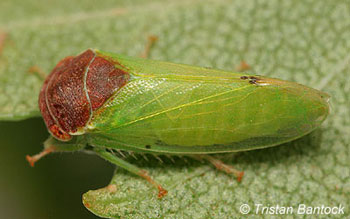
| Iassus scutellaris
(Fieber 1868)
Discovered
in Surrey in 1978, this species is now found widely across southern and
central England despite its classification
as Nationally Notable A. Associated with
English Elm Ulmus
procera and able to persist on low
regrowth following dieback due to Dutch elm disease, it is similar in
appearance to the common oak-feeding I. lanio but the
colour of the forewings is generally a much brighter lime-green.
More |
 |
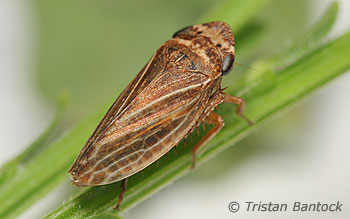
| Aphrodes makarovi (Zakhvatkin
1948) Previously
regarded as a form of A.
bicinctus, this taxon was raised to species status by
Ossiannilsson (1981). A. makarovi is
larger than A. bicinctus,
has pale wing veins and is much more common. The male genitalia are
also distinctly different.
More |
 |
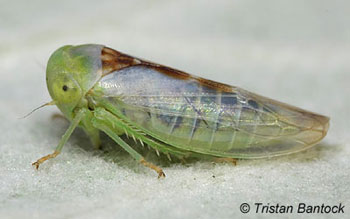
| Viridicerus usulatus
(Mulsant & Rey 1855) First
recorded in Norfolk in 1991, this species is now widespread throughout
much of England, Wales and as far north as Yorkshire on White Poplar Populus alba.
Although Idiocerines are generally a difficult group to
identify, V. ustulatus is distinctively
marked and also noticeably smaller than
other species
in this genus.
More |
 |
| Fieberiella florii
(Stal 1864) First recorded in 1998, this species has been found mainly in the London area on ornamental shrubs such as Photinia and other Rosaceae. It is also reported to feed on privet. More |
 |
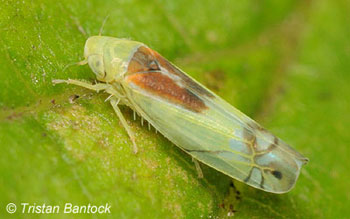
| Zyginella pulchra
Low 1885 This
species was discovered during 2001 in Kent, but not
found subsequently until 2007, when it was recorded from multiple
widely-spaced sites across southern Britain. Z. pulchra
has a rather unusual phenology for a leafhopper and is most easily
found during the winter, which it spends on various evergreens
such as Yew Taxus
baccata and Leyland Cypress x Cupressocyparis leylandii.
Adults move to Sycamore Acer
pseudoplatanus and mate in spring, the new generation
appearing in the autumn.
More |
 |
| Eupteryx decemnotata
Rey 1891 First
reported from Berkshire in 2002, this
species is associated with a variety of herbaceous plants on the
continent but in Britain has been mainly found on Sage Salvia officinalis.
It is now probably much more widespread.
More |
 |
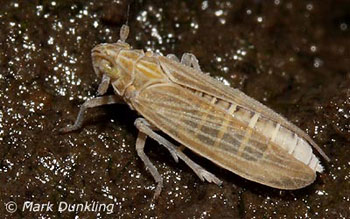
| Prokelisia marginata
(Van Duzee 1897) This
delphacid is native to the USA where
it is found in saltmarshes, feeding on Spartina alterniflora.
It has recently been introduced to
Britain and was first recorded in
2008 from the Hampshire coast in association with the closely related common
cord-grass Spartina
anglica.
It has colonised suitable habitat along the south and south-east coasts
of Britain with extreme rapidity and can reach very high densities.
More |
 |
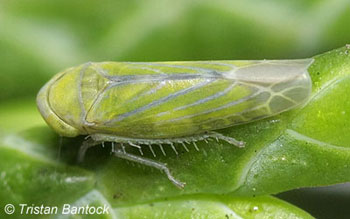
| Liguropia juniperi
(Lethierry 1876) A recent arrival to Britain, first noted in Peterborough during 2008 and since recorded from multiple sites in the south-east of England. The foodplants are ornamental cypresses, frequently planted in urban areas. More |
 |
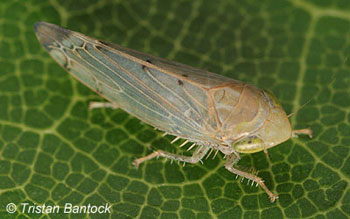
| Synophropsis lauri
Horvath 1897 Similar
in size and shape to Fieberiella
florii, this species is native
to south-eastern Europe and was introduced to Britain via imported Bay
Laurel Laurus
nobilis. It was
first recorded from the London area in 2007 and then
subsequently found more widely in south-east England and on the Channel
Islands. There seem to be
two generations a year and females may overwinter.
More |
 |
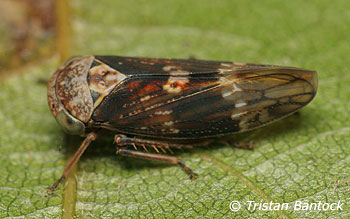
| Acericerus ribauti (Nickel
& Remane 2002) Like Acericerus vittifrons,
this leafhopper feeds on Acer
species and can be found on Sycamore Acer pseudoplatanus and
especially Field Maple A.
campestre in southern England. A. ribauti was
first recorded in 2007 but due to its similarity to A. vittifrons it is
unclear whether the species is a recent colonist or has been overlooked
in Britain for some time.
More |
 |
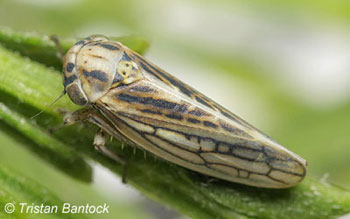
| Dryodurgades antoniae
Melichar 1907 This
distinctive member of the Agallinae is a very recent arrival in
Britain, first noted at a site in south Essex during 2008 and then
recorded from two sites in London a year later. The foodplant
is Broom Cystisus
scoparius.
More |
 |
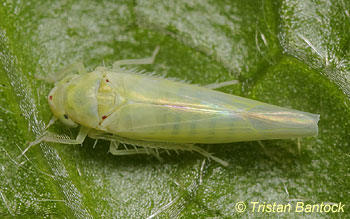
| Zygina nivea
Mulsant & Rey 1885 Recorded from several sites in London during 2010, this species is associated with White Poplar Populus alba and has apparently undergone recent range expansion in northern Germany (H. Nickel, pers. comm.) |
 |
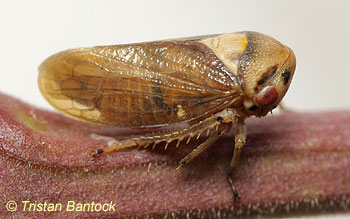
| Macropsis megerlei
(Fieber 1868) A small and distinctive Macropsis species which is associated with Burnet Rose Rosa pimpinellifolia and is known only from a single dune system in north Wales, where it was discovered in 2010. Since this is an unlikely site for a recent colonist, this species is probably an overlooked resident and should be searched for in similar habitats elsewhere. |
 |
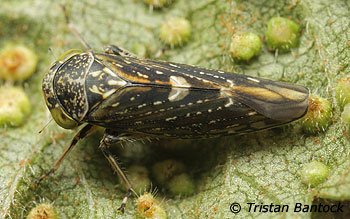
| Acericerus heydenii
(Kirschbaum 1868) This species is larger and darker than Acericerus vittifrons and A. ribauti and is associated with Sycamore Acer pseudoplatanus. It was found at a number of sites in southern England during 2010 and is presumably a recent arrival from the continent. |
 |
| Fieberiella septentrionalis
Wagner 1963 Very similar to F. florii and separable only by dissection, this species was found on a brownfield site in Yorkshire during 2010 when a number of specimens were swept from Grey Willow Salix cinerea. It seems likely that this population originated from imported landscaping materials. On the continent this species is often associated with Blackthorn Prunus spinosa. |
 |